
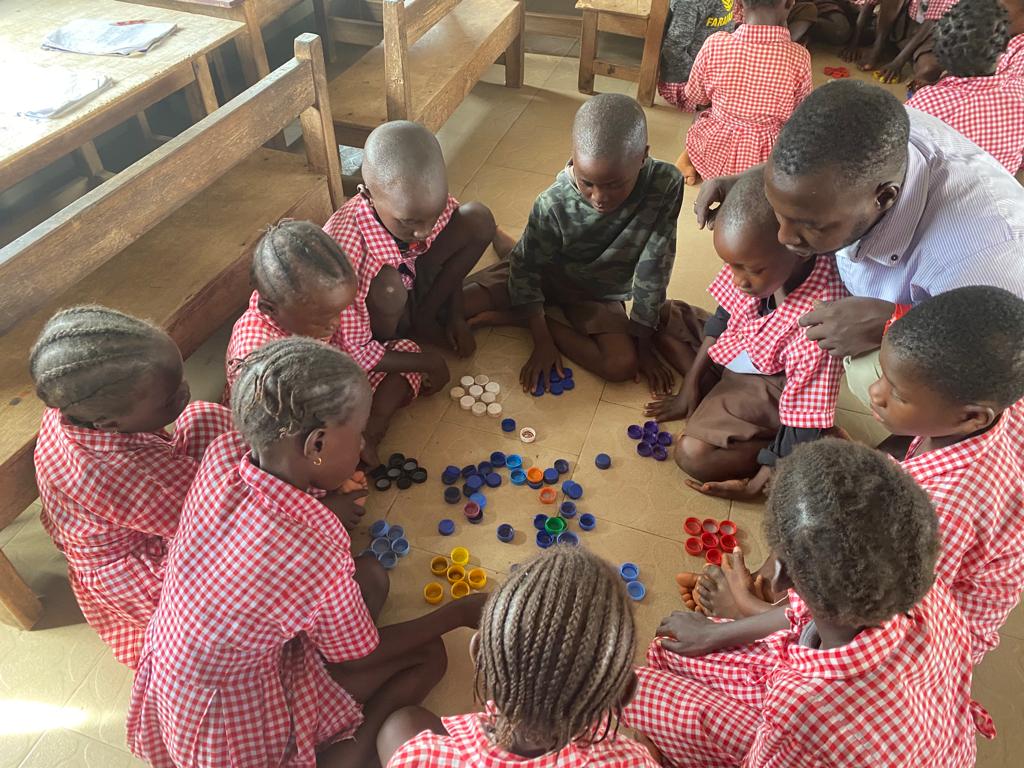
Donors may reasonably ask whether all the activity and expenditure above has had any impact on the development of the pupils and the capabilities of the teachers. Also, they will want to know the measurement has been done accurately, objectively and properly reported.
These are some of the challenges.
The staff at most schools joining our network had been neglected and they were, not surprisingly, demotivated and under trained.
Bad habits had become ingrained and often literacy, numeracy and English language skills were poor. The good news is that this was the first time in their careers they have felt valued and invested in and their motivation soared.
However, building their skills takes time and patience and it requires consistent hard work.
Measuring teacher development
In March 2023 we started measuring the performance of the Head Teachers and qualified teachers. The appraisal process we have adopted is straightforward, ranking each teacher at the end of term (3 times a year). The assessment is carried out by the project leader, his team of 3 inspectors and, importantly, an independent consultant who visits all the schools several times a term.
Using this scoring system:
| 8 | Excellent |
|---|---|
| 6 | Above average (can prepare and implement a lesson plan in line with curriculum, run joyful lessons, keep good order, show enthusiasm, uphold school regulations) |
| 4 | Below average (falls short of the level we are looking for) |
| 2 | Poor |
Though subjective, this process provides a measure of the overall standard of the teaching in the project and how it changes term by term.
Head Teachers
| Head Teacher | Mar 23 | Jul 23 | Dec 23 | Mar 24 | Jul 24 | Dec 24 | Mar 25 | Jul 25 | Dec 25 | Mar 26 | Jul 26 |
|---|---|---|---|---|---|---|---|---|---|---|---|
| Excellent | 3 | 3 | 3 | 4 | 7 | 7 | 6 | 7 | 8 | 4 | 6 |
| Above-average | 1 | 5 | 8 | 6 | 4 | 4 | 5 | 4 | 4 | 8 | 7 |
| Below-average | 5 | 2 | 0 | 1 | 0 | 1 | 2 | 2 | 1 | 1 | 0 |
| Poor | 2 | 1 | 0 | 0 | 0 | 0 | 0 | 0 | 0 | 0 | 1 |
| Average score | 4.9 | 5.5 | 6.5 | 6.5 | 7.3 | 7.0 | 6.6 | 6.8 | 7.1 | 6.5 | 6.6 |
Qualified Teachers
| Qualified Teacher | Mar 23 | Jul 23 | Dec 23 | Mar 24 | Jul 24 | Dec 24 | Mar 25 | Jul 25 | Dec 25 | Mar 26 | Jul 26 |
|---|---|---|---|---|---|---|---|---|---|---|---|
| Excellent | 3 | 4 | 7 | 9 | 8 | 8 | 10 | 7 | 17 | 13 | 20 |
| Above-average | 6 | 18 | 17 | 14 | 16 | 18 | 18 | 21 | 19 | 17 | 22 |
| Below-average | 22 | 13 | 9 | 6 | 7 | 5 | 9 | 13 | 7 | 12 | 1 |
| Poor | 4 | 0 | 1 | 2 | 0 | 0 | 1 | 1 | 0 | 2 | 1 |
| Average score | 4.5 | 5.4 | 5.7 | 5.9 | 6.1 | 6.2 | 6.5 | 5.8 | 6.5 | 5.9 | 6.7 |
Measurement of pupil development
In November 2020, UNICEF launched the ECDI2030 indicator SDG 4.2.1 “Proportion of children aged 24-59 months who are developmentally on track in health, learning and psychosocial well-being, by sex.”
In March 2024 GSS decided to adopt this assessment method and set up a process where the pupils are assessed 3 times at the ages of 40, 52.5 and 62.5 months. We have trained the teachers to carry out the 20 question assessments and the results analysed by GSS trustee Dr Nick Stevenson (formerly Head of Equity Research at SG Warburg and then at Mirabaud). The accuracy of the assessments are uneven at present and several of the teachers are being trained to understand how to make better judgements on a child’s attainments.
We have selected the early results we have confidence in to set the baseline which is showing, unsurprisingly, that Gambian children developmental scores are, on average, below the UNICEF ‘norm’ score for their age. We want to see the trendline for the development of our pupils rise faster than the line for the UNICEF ‘norm’ i.e. the developmental deficit narrowing over their time at our schools.
Furthermore, UNICEF analysis suggests that a child attaining an ECDI score of 17/20 or higher at 62.5 months is deemed ‘ready’ for primary level education. Though this would not prove that GSS’s intervention has been successful, measuring this will show how many of the children leaving GSS assisted schools will be ‘ready’ for their next school.
The data gathering, analysis and dissemination is being led by Dr Stevenson who is being assisted by members of the IT team at BPL (a global credit and political risk insurer based in the City of London). BPL have been major backers of the GSS project) and recently introduced us to OutSystems whose social impact team have provided free access to enable GSS to operate a cloud-based platform which our stakeholders will be able to access via a GSS app.
Timings for outputs
30 Nov 26 – GSS App developed & tested
31 Dec 26 – GSP and head teachers provided with access to the App
early Jan 27 – during GSS visit training and familiarisation workshops
31 Jan 27 – the Sept 26 intake are ECDI assessed
Mar 27 – results analysed by UK team and published in the Term 2 report (early April 27)
ECDI2030 20 question assessment
Learning
- say at least ten words
- speak using sentences of three words e.g. “I want water”
- speak using sentences of five words
- name an object he/she knows well
- correctly use any of the words ‘I,’ ‘you’ e.g. “I go to the store”
- recognise at least five letters of the alphabet
- give you three objects e.g. three stones
- count 10 objects
- know all numbers from 1 to 5
- write his/her own name
- do an activity such as colouring without giving up too quickly
Psychosocial well-being
- get along well with other children
- ask about familiar people other than parents e.g. “Where is Grandma?”
- offer to help someone who seems to need help
- seem to be very sad or depressed
- compared with children of the same age, how much does the child kick, bite or hit other children or adolts
Health
- dress him/herself, that is, put on pants and shirt without help
- fasten and unfasten buttons without help
- jump up with both feet leaving the ground
- walk on an uneven surface e.g. a bumpy path without falling